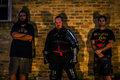
Some bands emerge from scenes. Others build their own in isolation. The Crypt (DC) belongs firmly to the latter.
Formed in 1998 in the unlikely setting of Fish Creek, Wisconsin, The Crypt began as a solitary attempt to fuse black, death, thrash, and doom into something deliberately unclassifiable; what its creator simply called “obscure metal.” With no local scene to plug into and limited access to music in the pre-digital era, the project was shaped as much by distance and determination as by influence. Tape trading, self-reliance, and a refusal to conform became foundational, setting the tone for a body of work that has remained fiercely independent for over two decades.
Now, with a series of carefully reconstructed early releases and new material on the horizon, The Crypt stands at a reflective point in its evolution—looking backward not out of nostalgia, but as a way of completing unfinished chapters, while continuing to push forward into stranger, more experimental territory. Plans for a full-length visual interpretation of Beholden to No One only reinforce that sense of restless creativity.
In this interview, we spoke with the mind behind The Crypt about origins, isolation, mortality, artistic freedom, and what it really means to create without compromise.
Origins & Early Vision
- The Crypt was formed in 1998 with the intention of creating “obscure metal.” How did you define that idea at the time, and does it still hold the same meaning today?
I love thrash, death, doom, and black metal, and wanted to combine all of them, as well as add other dark elements, hence the moniker “obscure” or “dark” metal. I never felt that we fit into any category, even then, and certainly not now with all the crazy stuff we throw in the mix. Also, despite certain ex-members having strong anti-religious convictions, I’m not cool with bashing someone’s faith. Though the Crypt has mournful, twisted, or aggressive ideas, I didn’t want to be associated with any of that “EVIL TR00 KVLT” crap.
- Coming out of Fish Creek, Wisconsin, how did your surroundings influence the band’s early identity and sound?
Now it’s different, but back in the 90’s we were super cut off from the outside world. We had no peers, no other metal bands around us, and I was pretty much the only serious metalhead in the region. We’re about 2 hours from the nearest city, which made attending concerts as a teenager really difficult. Just getting music was difficult as well—there was one music store in a neighbouring village, but the self-righteous prick who ran it had problems with the “naughty death metal” that I was buying, so we all stopped going there. No problem—I just started tape trading and mail ordering everything, and became far more determined and serious about music.
- What originally pushed you to start the project—was it a reaction to the scene, or a more personal creative drive?
I wanted to create my own music, a combination of everything that I was listening to, and as I mentioned, we didn’t have any scene here. There was a band from a town at the other end of the peninsula, about 40 miles away, and they inspired us. We have a vibrant art scene in the region, so there was always great music (classical, jazz, folk, etc.), but no metal. That’s where the Crypt came in.
But yeah, my own creative drive eventually became the force behind it all. I think that in the end, the Crypt sounds pretty unique!
Revisiting the Archive
- You’ve recently re-recorded and released material from your earlier years. What motivated you to revisit these recordings now?
My own mortality. It was the death of family members and the demolition of old buildings that really put things in perspective, and emphasized the fact that life is not infinite. Also, anything that goes undone has, over time, an increasingly lower chance of ever being completed. It had always bothered me that those two albums and EP were never finished, and listening to them now, they weren’t simply throw away first attempts, but the first steps on a long journey.
- In approaching these re-recordings, were you aiming for fidelity to the originals, or did you see this as an opportunity to reinterpret them?
I stuck very close to the originals. The structures are all the same, and almost all of the lyrics remain unchanged. There were a few lines that I had to tweak grammatically, and others that really were silly, but I tried to leave things the way they were. There are a few super immature things I left in there specifically because I thought it really captured how my teenage self tried to be edgy. If anyone is offended by that, they can jump in a time machine and try to talk my younger self out of it.
- Did returning to this material change your perspective on it in any unexpected ways?
The coolest thing was that revisiting it brought me back to the places and times when the material was composed, and I mean that in the most positive ways (mostly). With the first album, Corpus Hypocrisy, I felt an intense nostalgia for my early years, a huge appreciation for the people who are no longer in my life and the places I will never see again. The second album of the rerecorded stuff, Pristine Visualization, however, was written when I was living in France and attending university. Those were some awkward, not as pleasant memories!
And as much as I’ve said that some of the material was immature, I was pleasantly surprised how good it actually was, especially Pristine Visualization, which was quite experimental at the time. I also reached out to a bunch of the international bands with whom I used to correspond, and got their vocalists to do some guest vocals—something I couldn’t have done back in the day! Reconnecting with them was great, too, and forced me to listen to some old favourites.
The acoustic EP, Horizons over the Phenomena, has a song called “La Grande Errance,” and it was written when I had just graduated high school and about to ship off to France. It’s basically about traveling, something that I did intensely until 2017, when I stopped. Listening to that, and thinking about how I visited thirty something countries, and lived in two other countries for eight years, is really a lot to take in. It makes me feel deeply satisfied in what I have accomplished with my life.
Sound & Evolution
- Over the years, your discography has maintained a distinct atmosphere while still evolving. How would you describe the defining characteristics of The Crypt’s sound?
That’s a very good question! In general, it’s dark and melancholic, usually metal, but not always. I always think that a metalhead with an open mind would enjoy pretty much anything we make, because I’m always coming from a metalhead’s perspective. And judging by the fact that our most well received album is our acoustic album (Embers of Limerance), I think that we are doing a pretty good job of that.
- How has your songwriting process changed since your earliest releases?
Not as much as you’d expect! For the most part, it’s always been just me, composing material and demoing it with a drum machine, but I’ve worked in a more creative capacity with some friends to create music here and there. I really like to have other perspectives on the music, but since the Crypt is my only musical project, I work really fast, and most people prefer a more laid back approach. I’m really forgiving of people admitting they can’t participate in certain capacities, but ghosting is a huge problem—we Midwesterners are notorious for being agreeable rather than honest.
- Are there particular influences, musical or otherwise, that continue to shape your work today?
The biggest thing is probably nature, and outdoor activities like hunting, camping, and cross country skiing. Pretty strange, eh? My area is rural, with lots of amazing natural features, and that’s always inspired me in a good way. When you compare the modern, human world with that of the great outdoors, it just feels fake and empty. At least my misadventures with modernity are great fuel for aggressive metal songs!
Themes & Intent
- Your work often suggests themes of defiance, spirituality, and transformation. What conceptual ideas tend to guide your lyrics?
Freedom. Not in a banal, political sense. As I’ve noted before, the material world, and most certainly the modern world, is a stagnant cesspool designed to mire the individual in bullshit, and subvert energy and faith into useless endeavours. I’ve always viewed the Crypt as a vessel for confronting and escaping that.
- Do you see your releases as connected parts of a larger vision, or as individual statements?
They’re all parts of my conscious creation, so they’re at least shades of similar ideas. As much as I try to be “more than human,” there are a lot of common themes like loss, heartbreak, conflict, and suspense in my music. It’s all leading to the same place, and revisiting those old albums really showed me that my instincts have always been the same. I’m walking the same path, just doing it with a more colourful vocabulary and with more precision.
- How do you balance atmosphere and intensity when composing?
It’s whatever the song demands. A song like “Limnic Death,” about a lake spewing poisonous gas had to be full on intensity, whereas “Memories of the Sky” is a love song, about seeing some fantastic woman that brings all sorts of beautiful images to mind. Obviously, with the “symphonies” from Gichigami, it was very easy, because I was writing about a concept I intimately knew (the Great Lakes), and each one has its balance of violence and beauty.
Gichigami was some of the most fun I’ve had creating. How does one express the cold, malevolent vastness of Lake Superior, but also it’s forlorn and starkly beautiful features? And how do you do that without words? I’ll give you a few hints: drop A tuning, a crawling tempo, and variations of the Locrian mode.
Visual Direction – Beholden to No One
- You’ve mentioned the possibility of creating a full-length video for Beholden to No One. What sparked that idea?
That was our drummer/producer/sound guy, Dan Smrz, who also does some visual stuff, and our lyrical contributor, Jacob Wegehaupt, who is a film maker by education. We have a film festival every spring in our area, and Dan wants to do something for it. It’s a very abstract album, with super strange sounds and bizarre lyrical ideas, so the possibilities with film are enormous.
- What form would you envision for that project—a narrative piece, a visual album, or something more abstract?
I’m not quite sure, because Dan and Jacob are going to helm that project, but I’m leaning more towards a loose narrative with room for interpretation. Kind of Beyond the Black Rainbow meets Eraserhead.
- How important is the visual dimension in expressing what your music represents?
I think they’re intriniscally tied. I’m very picky about the artwork for each album, specifically the colour schemes involved, because I feel that it must match the music therein. My guitarist/keyboardist, Adam Haste, has a weird synesthesia where he sees notes as colours (E is blue and D is black, for example), and though I don’t have quite the same experience, I always have a visual experience with music.
Looking Forward
- You’re currently working on new material for a forthcoming album. How does it build on or diverge from your previous work?
It’s a departure of course! Not super big, but it’s going to lean towards slower, crushing tempos, very doomy with some serious nods to Candlemass, Trouble, and early Katatonia. I feel like it’s got some of the vibes of Gichigami, song orientated with anguished, harsh vocals. The perfect soundtrack to freezing your ass off and being sad on a long winter night next to Lake Michigan!
- Are you consciously exploring new directions, or refining your established sound?
This one will be more refinement. We’ve got some doomy songs already, but this will be a whole album focused on crushing riffs, mournful melodies, and unsettling atmospheres. I’m planning to use a lot of clean 12 string bass and have Adam play organ on a lot of the stuff.
- What themes are emerging in this new material?
It’s very focused on loss, mourning, and sadness. Those deaths in the family the demolition of the old architecture around here all fill me with melancholy at their loss and bitterness at a world becoming profoundly uglier and more stupid. Like I’ve said, perfect material for a metal album!
Underground Perspective
- The Crypt has remained firmly rooted in the underground. What does that independence mean to you at this stage?
It’s EVERYTHING. Freedom, again. I couldn’t make the music I like, when I like, as quickly as I like if the Crypt were a normal band. I only do this for myself—I couldn’t care less if other people buy my albums, or even like them. The creation of each takes me on a really deep, quasi-spiritual journey, which is the end in and of itself. Selim Lemouchi, of the Devil’s Blood, once noted the same thing—he could have been a big time rock star, but he refused to play the game. Same thing with Jon Nodtveidt of Dissection. I have nothing but the utmost respect for that attitude. Plus, it gives me great delight to know that third parties, like record companies, tax men, and other leaches get jack shit from my art!
- How do you view the evolution of the underground metal scene since the late ’90s?
Good and bad. The good part is that I can easily communicate with people on the other side of the world, buy their music, and even have them on my albums. Most of my albums wouldn’t exist without the cast of musicians I hire from abroad—there are no metal session musicians in my area. So that’s a huge plus that I can’t understate.
But I really miss the tape trading, getting packages from distant lands, and people valuing the music. Now people want you to pay them to listen to your album! Insane! I loathe AI with every fiber of my being, but I tolerate bands from the third world using it for cover art.
The absolute worst, however, has to be the digital panhandling in the metal scene. Not crowdfunding for music related stuff—which is really cool, but just openly begging for money. Then again, back in the 90’s I would sometimes get clueless, ham-fisted requests to help some sad bastards get a work visa to Los Angeles, so I guess this is just the natural evolution of things. Oh well.
- In an era of constant digital exposure, does “obscurity” still have value?
I’d like to think so! I’m much more likely to check out a band if I get a flyer in the mail than if I see an ad on Instagram. Most of the stuff I find comes from me actively looking for it or a friend suggesting it to me. Any ads or stuff like that feel way too “mainstream” to be taken seriously.
Closing
- For new listeners, which release would you point them toward as an entry into The Crypt’s world?
I have three favourite albums of ours. For non-metalheads, I would recommend our acoustic album, Embers of Limerance. That’s my absolute top pick, all time favourite. The songwriting, the musicianship, and the sound are just perfect. I had the most input from Adam on any album, as well, so it’s more rounded out. 2020 was a super shitty year for both of us, so that album just feels like the first warm day of spring.
For our most orthodox, true death/thrash/black/super duper heavy stuff, check out Истребитель (aka: Exterminator). It never lets up and it’s got just enough progressive weirdness.
For those who don’t like harsh vocals, Odal is the best. It was the first album I made after moving back to my homeland in the United States, so it’s brimming with passion and renewal. There are lots of proggy touches to that as well. Someone even called us “Great Lakes Bathory!” I was so honoured!
- After more than two decades, what continues to drive you creatively?
I haven’t run out of ideas, and getting older gives me new experiences and express through music. I want the musical pallet of the Crypt to be so broad that I can create something if I live to be older and crustier—even if it’s some moody jazz fusion or ambient, Burzum style prison music.
- What does Beholden to No One represent for you, beyond its title?
It’s probably the weirdest we’ve ever managed to get, unless we get zapped with some secret CIA/extraterrestrial mindbending drugs! Using non-musical instruments to make sounds that are nearly non-musical in formats that can barely be described as songs…yeah, that’s about the biggest “up yours” I can send to anyone who thinks the Crypt owes them something or that we have an obligation to let them commandeer my art for whatever crap they want to push. Beholden to No One indeed!
Bandcamp: https://thecryptdc.bandcamp.com/

